 On this page you can find news and events on various key topics for the care sector.
Patient Safety Alert has just come in which is linked to provision of hoist and slings, which requires actions and assurances.
The full details are in the alert National Patient Safety Alert: Patient hoists and slings (all types): risk of death and serious harm from falls (NatPSA/2026/005/MHRA) - GOV.UK
The Required Actions are as follows and need to be completed by 16 September 2027.
- Ensure that standardised pre-use checks are in place and completed for all hoists and slings (aligned with manufacturer’s IFU) to identify unsafe states. Pre-use checks should include a pause-and-check step after initial load take-up but before the patient is entirely lifted to verify that all sling attachment points are securely attached before proceeding.
Further Information from MHRA: Pre-use checks should be capable of identifying missing components, worn or damaged carabiners and retaining features, damaged or incorrectly seated sling loops, and any other damage or degradation. The pause-and-check step is particularly important for loop-type sling attachments. Before fully lifting the patient, pause when the sling is taut and the patient’s weight is partially supported to confirm all attachment points are secure. Any hoist or sling found to have missing, worn, damaged or incorrectly assembled components must be immediately removed from service, clearly marked as DO NOT USE, and reported through the relevant route in the organisation.
- Review and document the compatibility of all hoists and sling combinations in use across your organisation. In exceptional circumstances, where compatibility cannot be confirmed through the manufacturer’s IFU, a risk assessment with supporting technical evidence must be completed by a qualified person. Maintain a local register of approved combinations and ensure this is accessible to all relevant staff.
- Further Information from MHRA: Compatibility should be confirmed through the manufacturer’s Instructions for Use (IFU). In exceptional circumstances, where third-party slings are used, compatibility must be verified by an appropriately qualified person, documented and supported by evidence. A documented, patient specific risk assessment must confirm that the hoist and sling combination is appropriate for the patient. Risk assessments must be repeated whenever the equipment combination or the resident’s/patient’s condition changes (e.g. weight, posture, tone, cognition, pain, sitting balance, ability to participate in transfers, tolerance of hoisting). This also applies to accessories and attachments such as weighing scales; all accessories must be compatible with the hoist and fitted in accordance with the IFU.
- Review the medical device management systems (inventory/database) for your organisation to ensure all patient hoists and slings, including those provided to a community setting, are identified and recorded. These must include maintenance, LOLER examination and device replacement plans.
- Further Information from MHRA: For more information on a medical device management system (inventory/database), see guidance on Managing Medical Devices and Devices in practice: Checklists for Using Medical Devices. This should include as a minimum the manufacturer, make and model, lot number, location and date of last service, date of end of service life, date of last LOLER examination and next services and LOLER examination due dates for the device.
- Ensure all hoists are maintained, serviced and examined under LOLER and in accordance with manufacturer’s IFU, with records kept up to date. Remove from service any hoist with overdue examinations or unresolved defects. Slings should be regularly checked in line with manufacturer instructions.
- Further Information from MHRA: Under LOLER, thorough examination by a competent person is required at intervals not exceeding 6 months. Pre-use checks are not a substitute for systemic maintenance programmes and statutory examinations. If maintenance or servicing is outsourced, compliance with the schedule should be monitored.
- Ensure staff receive role-appropriate training with regular updates. Training should cover use in accordance with manufacturer’s IFU, pre-use checks, hoist-sling compatibility, correct fitting and attachment, identification of unsafe states, and how to stop, escalate and report concerns. Training records must be maintained.
a. Training for staff (and patients and their families or carers where applicable) should be relevant to their role and include the relevant hoist and sling types in use, correct attachment and fitting techniques, recognitions of unsafe equipment states, when to stop, escalate, and report incidents and near misses to the Yellow Card Scheme and via local reporting routes. Training content should be relevant to the types of hoists, patient groups and care settings where staff are working. Training should also cover safe handling and transportation of hoists, particularly in multistorey settings .


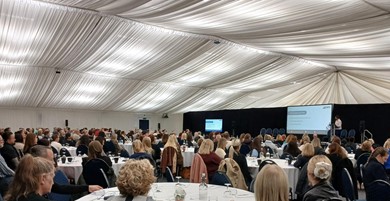
 On 10 October we held another successful registered manager conference and was pleased to be joined by our Medway Council colleagues and providers.