
Safeguarding Adults
Adult safeguarding explained
Adult safeguarding is about keeping people safe and protecting them from abuse and neglect wherever possible.
Section 42 of the Care Act 2014 states that safeguarding enquiries should be made where:
- a person is 18 years or over;
- a person has needs for care and support;
- is experiencing, or at risk of, abuse or neglect; and
- as a result of their care and support needs, is unable to protect him or herself against abuse or neglect, or the risk of it.
The Care Act 2014 sets out the six following principles that should underpin the safeguarding of adults.
Empowerment
People are supported and encouraged to make their own decisions and informed consent. "I am asked what I want as the outcomes from the safeguarding process and this directly informs what happens."
Prevention
It is better to take action before harm occurs. "I receive clear and simple information about what abuse is. I know how to recognise the signs, and I know what I can do to seek help."
Proportionality
The least intrusive response appropriate to the risk presented. "I am sure that the professionals will work in my interest and they will only get involved as much as necessary."
Protection
Support and representation for those in greatest need. "I get help and support to report abuse and neglect. I get help so that I am able to take part in the safeguarding process to the extent to which I want".
Partnership
Services offer local solutions through working closely with their communities. Communities have a part to play in preventing, detecting and reporting neglect and abuse. "I know that staff treat any personal and sensitive information in confidence, only sharing what is helpful and necessary. I am confident that professionals will work together and with me to get the best result for me."
Accountability
Accountability and transparency in delivering safeguarding. "I understand the role of everyone involved in my life and so do they."
Warning signs
- Being quiet, reserved and distant
- Being depressed, anxious or distracted
- Changing their appearance either to hide injuries like wearing long sleeves or more make-up or to meet the abusive person’s expectations
- Receiving or making repeated calls or texts when they aren’t with their partner or family
- Beginning to isolate themselves
- Not being as social as they used to be, cancelling plans or not contacting their friends
- Taking the blame for any problem in their relationship
- Having lower confidence or self-esteem
- Excessively ‘clock-watching’ or being anxious about getting home on time
- Having someone else who appears to make all the decisions for them
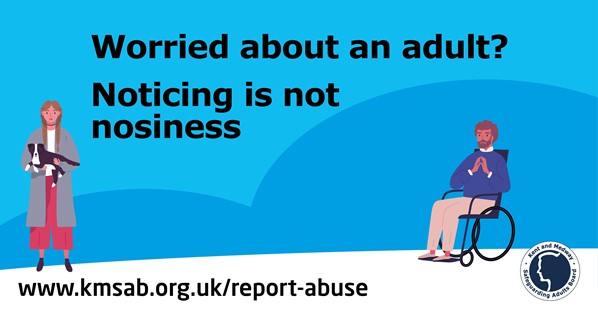
Adult abuse. See it, report it, stop it.
We all have a responsibility to look after one another, but some people don’t report their concerns because they don’t know the key signs that something is wrong, they feel it isn’t their business or they don’t know who they should talk to.
The result is that councils, hospitals, police and other organisations miss out on important information that could help them protect adults from exploitation and abuse.
By working together with Kent's many organisations and the public, we aim to empower people to act when they are worried about the welfare of another person by ensuring they are confident of the key indicators of abuse and know how and when to report their concerns.
For information on reporting your concerns, click here.
Deprivation of Liberty Safeguards (DoLS)
Deprivation of Liberty Safeguards (DoLS) under the Mental Capacity Act 2005, exists to safeguard individuals when a deprivation of liberty is an unavoidable part of a best interests care plan, where they lack the capacity to make decisions about their care, treatment and accommodation.
A Deprivation of Liberty is:
- putting someone under the deprivation of liberty safeguard to keep them safe
- restricting someone's freedom to give them constant supervision and care
- for those who are in a care home or hospital for treatment but cannot make choices in their best interest
If someone is under a Deprivation of Liberty:
- a representative will be identified. This will be a family member, friend or a paid representative who will visit and check they're being looked after in a way that means they're safe.
- they can ask for a review
- they or their representative disagree with the deprivation, they can ask for the court of protection to decide if they should be deprived of their liberty.
To find out more about the DoLS process in Kent, visit the Kent County Council Website.
To find out more about the DoLS process in Medway, visit theMedway Council Website.
To read further information on safeguarding, visit the Kent County Council Website.